

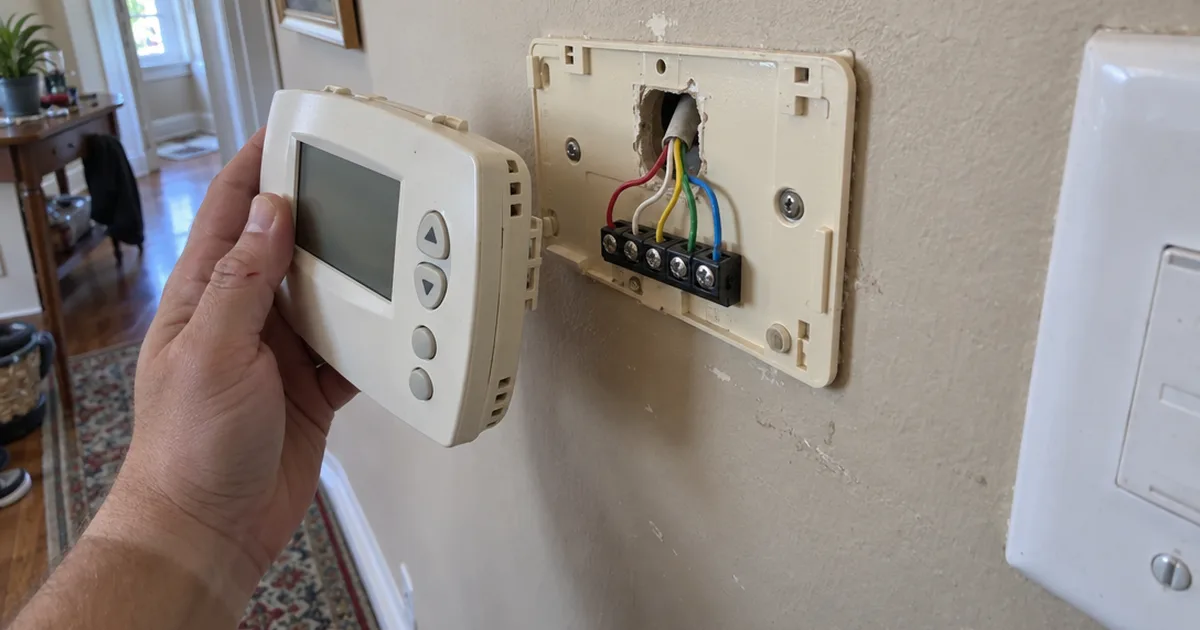
Homes built in the last 40 years usually already have a C wire.
That’s the rule of thumb from Copeland’s Sensi support team, and a spare thermostat C wire is sometimes just folded back into the wall, unused.
So before you buy an adapter or book a technician, take a look.
With the breaker off, one look behind the faceplate tells you whether you have one, and there are 5 fixes if you don’t.
What Is a C Wire on a Thermostat?
A thermostat C wire, short for common wire, is the return path that completes the 24-volt circuit started by the R wire.
Lennox explains that the R wire delivers 24-volt power and the C wire provides the return path for that current.
R pushes power in, and C gives it a way back.
That loop keeps the thermostat powered all day, not just when it calls for heat or cooling.
That low voltage comes from a small step-down transformer inside your gas furnace or air handler.
So is the common wire “hot”?
R is the hot feed and C is the return, but both carry current whenever the furnace has power.
This low-voltage circuit is also a different thing from the neutral wire for a smart switch in a light switch box.
Why Smart Thermostats Need a C Wire
Smart thermostats need a C wire because their touch screens, sensors and Wi-Fi radios never shut off. Lennox says that without a C wire’s constant flow, smart thermostats may lose connection, reboot frequently or fail to perform certain functions.
An old dial thermostat only had to open and close a circuit.
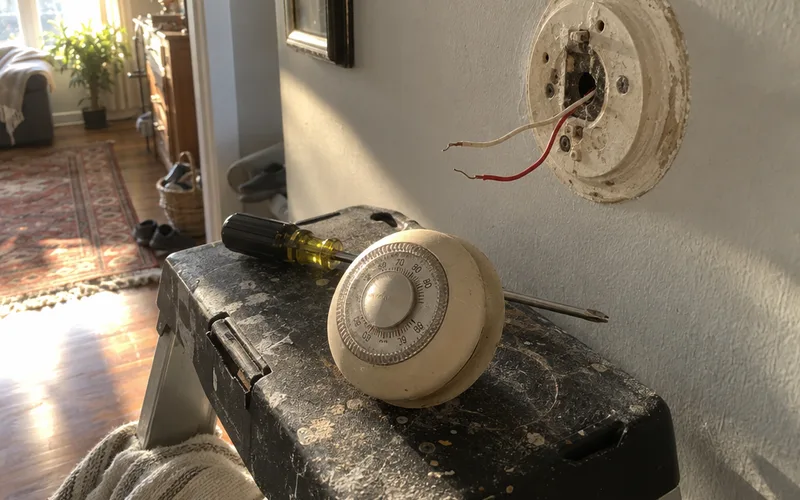
A smart thermostat is a small computer, and that’s a bigger power job.
In fact, Honeywell Home’s support page, last updated January 29, 2026, says C wires are required on all Resideo Wi-Fi thermostats.
That’s why fixing a Honeywell Wi-Fi thermostat with no C wire starts with finding or adding one.
Without a C wire, many smart thermostats fall back on “power stealing,” Lennox notes, pulling small amounts of power from the system’s control circuits.
That trick can cause glitches or interfere with your heating and cooling.
There are exceptions:
- Battery models such as the Sensi and Sensi Lite skip the C wire on conventional heating and cooling systems.
- Sensi says heat-only systems such as boilers, plus cool-only, heat pump and zone systems, still need a common wire.
- Sensi also lists a common wire as required for Apple HomeKit on its Sensi smart thermostat.
So if you’d rather skip wiring work, compare the smart thermostats that work without a C wire and check your system type first.
What Color Is the C Wire on a Thermostat?
The C wire on a thermostat is usually blue or black. But Sensi’s support page notes that C wire color isn’t standard across all thermostats.
Lennox adds brown to the list and calls blue the most common.
Here’s the usual color code, terminal by terminal:
| Terminal | Usual color | What it does |
|---|---|---|
| R (Rc, Rh) | Red | 24-volt power from the transformer |
| C | Blue or black | Common return for steady power |
| W | White | Calls for heat |
| Y | Yellow | Calls for cooling (compressor) |
| G | Green | Runs the blower fan |
The catch is that installers sometimes reuse spare wires, so a blue wire on the W terminal is a W wire.
The terminal letter decides what a wire is, not the color of its jacket.
That holds for a Nest, an ecobee or a Honeywell, so check Nest thermostat compatibility or your brand’s wiring tool by letter.
How to Find the C Wire for Your Thermostat
To find the C wire for your thermostat, look for a wire on the C terminal behind the faceplate. If there isn’t one, check for a spare wire in the wall and at the furnace control board.
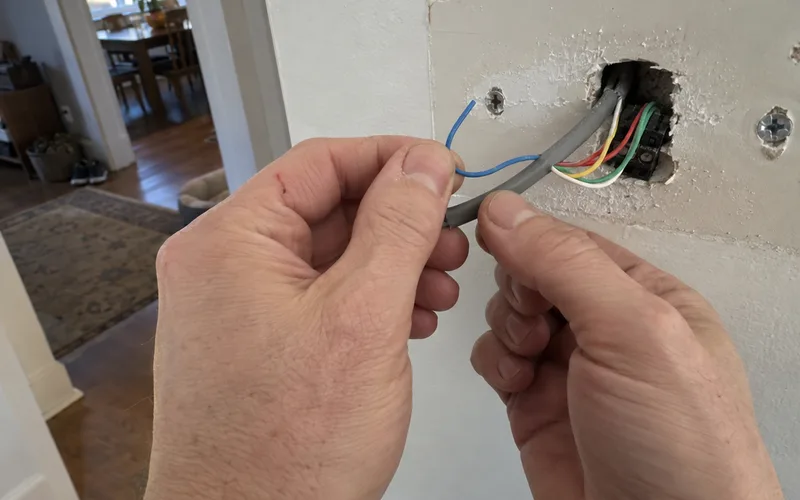
Here’s the order Honeywell Home and Lennox both follow:
- Turn off the breaker or service switch for your furnace or air conditioning. Turning off the thermostat doesn’t cut power to the equipment.
- Change the temperature setting. If nothing runs within 5 minutes, Honeywell says the power is off.
- Pull the thermostat off its wall plate, leave the wires connected and photograph every terminal.
- Look for a wire on the terminal marked C. If one is there, you’re set.
- Gently pull the cable out and look where the conductors leave the outer sheath. A spare folded back into the wall can become your C wire.
- Open the furnace, air handler or other heating system and find the control board. A wire on its C terminal means a common wire is available there.
A spare only works when both of its ends are connected: to C at the thermostat and to C on the board.
Honeywell says to strip at least 1/4 inch of the spare and leave any wire already on the board’s C terminal in place.
Board layouts vary, so check where the C wire connects on the furnace before you loosen screws.
Then close the furnace cover fully, because some systems won’t power up if it isn’t.
Do Older Homes Have a C Wire?
Older homes often lack a C wire at the thermostat. Lennox says many were built for mechanical thermostats that needed only 2 to 4 wires.
Newer homes are a better bet.
Sensi’s rule of thumb is that homes built in the last 40 years generally have the wiring for any smart thermostat, including a C wire.
There’s also a common in-between case.
Lennox points out that a C wire can be connected at the furnace board but never run up through the wall to the thermostat.
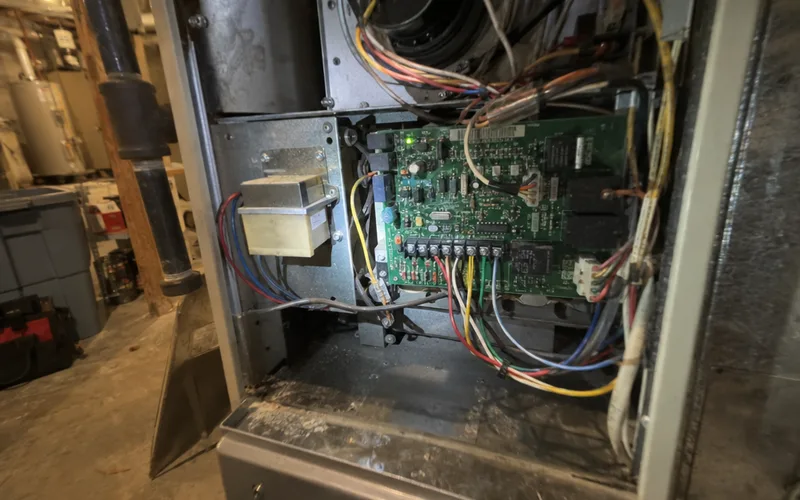
So even in an older house, check the board before you give up.
What to Do If You Don’t Have a C Wire
If you don’t have a C wire, you have 5 fixes: a spare wire, the G wire, an adapter, a new cable or a battery thermostat. They’re listed here from least to most work:
- Spare wire: connect an unused conductor to C at both ends. Lennox calls this usually the simplest and cleanest solution.
- G wire swap: move the fan wire to C at both ends. It works, but you lose the fan-only setting.
- C wire adapter: a small box at the furnace that lets 4 wires do the work of 5.
- New cable: Lennox calls a new wire the most reliable long-term fix and says a pro should run it.
- Battery thermostat: skip the wire if your system type allows it.
Which one fits?
Use a spare if you have one. If not, an adapter is usually next, and these options when there’s no C wire cover each fix in depth.
For a permanent fix, read up on running a new C wire first, so you know what the job involves.
How Does a C Wire Adapter Work?
A C wire adapter combines the fan and cooling signals at the furnace, which frees one wall wire to act as the common wire.
Honeywell Home’s adapter steps say it converts G into C and Y into K. Your system needs both a G and a Y wire to use one.
At the thermostat, the old green wire moves to C and the yellow wire to K.
Skipping that move is a classic mistake: one owner in a Wyze forum thread had a thermostat that just clicked until the G wire went on C.
At the furnace, the adapter sits between that cable and the control board, mounted inside the cabinet.
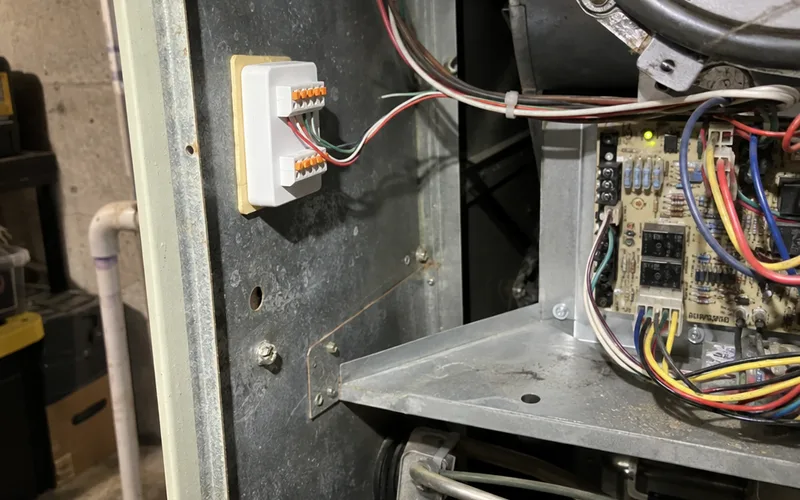
Note: Connections on 2 R terminals at the board mean a two-transformer system, and Honeywell says you’ll need extra help.
Brands sell their own versions, such as Google’s Nest Power Connector and the ecobee power extender kit, and the idea is the same.
Keep your adapter’s manual open beside a full C wire power adapter installation walkthrough.
When to Call an HVAC Pro
Call an HVAC technician when you can’t tell which conductor is which, can’t find a spare or don’t want to open the furnace. Lennox and Honeywell Home draw the same line.
Heat pump systems deserve extra care.
A heat pump needs a common wire even for Sensi’s battery models, and its extra terminals leave more room for mistakes.
Prices vary by home, so compare quotes against typical smart thermostat installation cost figures. Then plan the rest with a smart thermostat installation checklist.
New to all this? The Getting Started basics show where the thermostat fits with your other devices.
Pull the faceplate this week, take one clear photo of the terminals, and you’ll know which fix you need.
Frequently Asked Questions
Is a common wire always hot?
No, the common wire is the return side of a thermostat circuit, while the R wire carries the 24-volt power, according to Lennox. Both carry current whenever the furnace has power, so turn off its breaker before you touch either one.
Is red a common wire?
No, a red thermostat wire is normally the R wire, which brings 24-volt power from the transformer. The common wire is usually blue or black, but trust the terminal letter over the color.
Can I use the G wire as a C wire?
Yes, the G (fan) wire can sometimes be moved to the C terminal at both the thermostat and the furnace board, and Copeland’s Sensi support team lists it as an option. You lose the fan-only setting, so use an adapter if you rely on it.
How do I wire a heat pump thermostat?
A heat pump thermostat is wired by terminal letter, matching each wire to the same letter on the new thermostat, and Sensi says heat pump systems need a C wire. Photograph the old wiring first, and call an HVAC technician if the labels don’t match.